However, something immediately stuck out as being off:
‘MarchED’? Why the past tense? How about just ‘march’?
Few things are more timeless than music.
Music is never old.
It is always new, and present.
When played live, it is of that very moment – on the air and in the ear.
Recorded music – thanks to the listener who receives it, who drinks of it, who communes with it – is also similarly alive.
Peart (while also a compelling wordsmith) exemplified what a drummer / percussionist does best – being simultaneously the heartbeat of the music while manipulating the one thing that makes us all mortal: time.
Stretching, playing, suspending, even stopping time itself.
Effectively giving us – the listeners – the gift of the infinite. Time Stand Still.
A contemporary rhythmic instrument often used in rituals where groups of people gather to perspire.
The long line
Is one of the measures of a great tune whether it translates to other instruments, to other genres, other artists, yet still has the capacity to move you?
American composer Aaron Copland has written about the ‘long line’ – “a sense of forward motion … the feeling for inevitability, for the creating of an entire piece that could be thought of as a functioning entity.”
I’ve misinterpreted this phrase to mean a long line that carries through the work of an artist that ties it all together and makes it recognizable. I like that, but not sure that’s how art works. At least, not in the moment. Maybe only in retrospect.
I like even better the idea that there might be a REALLY long line in music, that ties listener and performer and composer and all different types of music together, and goes back a long way. Who knows how long?
…
In high school orchestra, we played a transcription of some of ‘Pièces de Clavecin’ by 18th century French superstar composer Jean-Philippe Rameau, tunes written originally for the harpsichord.
They sounded pretty good in the hands of a bunch of 16 to 18-year-olds!
Those pieces stuck with me, and I still play a bit of one tune on the violin today. It has something to say – to me, at least.
After listening to David Bowie recently, I posted that I still missed him. After the second anniversary of his passing, a friend had gotten me grooving on the Space Oddity’s slightly more obscure stuff, such as ‘Loving the Alien’, ‘This is Not America’ with Pat Metheny and Lyle Mays from the Falcon and the Snowman soundtrack (remember that one? Me either…) and ‘I’m Afraid of Americans’ with Trent Reznor of Nine Inch Nails. Is there some be-more-inclusive-of-immigrants theme going on there…?
20th-21st century English composer, vocalist, multi-instrumentalist, and fashion icon David Bowie. Like, duh. Photo: bbc.co.uk.18th century French composer, multi-instrumentalist, and not-too-shabby dresser himself: Jean-Philippe Rameau.
Anyway.
While at the gym later that evening – a bit tired of the fight between the Prog Rock in my headphones and the workout music channel on the screens around me – I decided to go for something totally different and acoustic, and Spotify-ed my old bud Rameau.
Most of the top results were for piano – which is not uncommon if one searches for, say, Mozart or Bach: pieces intended for harpsichord or pianoforte often end up on piano for modern audiences.
Does it still fly?
Yeah. Sure did.
I was probably the only person on a treadmill being spirited along by a French guy dead before America was America.
Compare two delightful performances of a particularly cool piece by Rameau, first on harpsichord, its ‘intended’ instrument:
…and next, on piano:
They’re both great, right?
…
I love that this cycle never ends. The long line. An endless wire.
Later that night, another friend had responded to my Bowie post: “Seen ‘The Life Aquatic [with Steve Zissou]’?”
I haven’t, but I know Brazilian singer/songwriter/actor Seu Jorge’s covers of David Bowie songs feature prominently.
I look forward to experiencing Bowie through a new person, a new ‘instrument’.
In the moment, we’re usually too preoccupied to recognize the earth moving beneath our feet.
Discovering Randy Foy’s Music Box at age 17 was one such moment for me. Not just a tremor, but a tectonic shift.
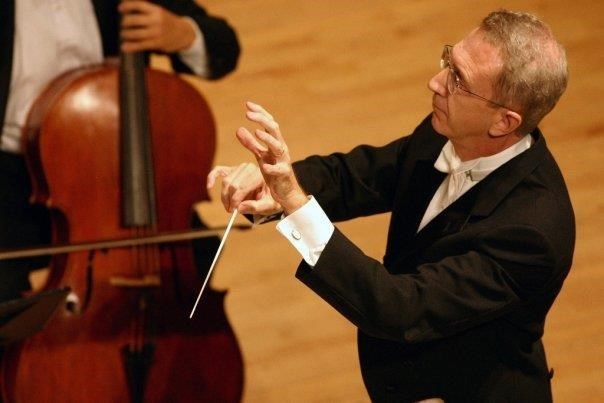
Randy was the orchestra conductor – and director of the music program – at the North Carolina Governor’s School, a program started in 1961 by North Carolina Governor Terry Sanford to give kids from a variety of backgrounds the opportunity to engage with contemporary (I guess they called it ‘Modern’ then) thinking in the arts and humanities over a 6-week summer program. For a mostly rural state where the majority of folks came from agriculture and manufacturing, this was a pretty progressive idea, and an opportunity the likes of which some had never had before.
I’d been nominated to Orchestral Music by my high school music director, and, after auditioning – something that often made me quite nervous – I was accepted into the program in the summer between junior and senior year.
Standing in front of cardboard box filled with records and CDs – Randy Foy’s Music Box – I didn’t realize at first the extent to which its contents would inform my listening habits for the next 29 years (and counting). I can safely say that because of Randy – and his music box – I will usually still go out of my way to go to a concert if they’re playing something “modern”.
While rehearsing the first movement of Dmitri Shostakovich’s Fifth Symphony, Maestro Foy – from the podium – described a particular passage to us. Randy had a way – as does every good music director – of not only inspiring you to play your best without making it seem like work, he had a way of making you fall in love with the music.
That’s why when he finished the description, there was a pregnant pause before he said “…there won’t be a dry seat in the house.” We all knew what he meant, even as we began to roar with laughter.
And in that magical moment, there were surely at least a few non-dry eyes on stage.
Sadly, Randolph Mitchell Foy passed earlier this year, yet his legacy lives on in the thousands of lives he touched through music in his role as researcher, teacher, and conductor of the Governor’s School Orchestra, North Carolina State University (NCSU) Orchestra, the Raleigh Civic Symphony, the Raleigh Civic Chamber Orchestra, and others.
He’ll also feature in future posts here, as the following could never have happened without his influence. They might very well include:
Steve Reich’s ‘Octet’ – a tape so worn-out from being overplayed in a brown Toyota Tercel, it’s unlistenable. Yet, I can’t bear to throw it out.
John Adams – not the president. A composer. A living composer (imagine that!) with his finger on the pulse of America.
Two marching bands collide, according to insurance salesman and iconoclastic composer Charles Ives.
(Also, I promise that I’ll share – over several blog entries – the contents of that box, to the best of my memory.)
“What you have in your head, put it down on paper. The head is a fragile vessel.” — Dmitri Shostakovich
When Russian composer and pianist Dmitri Shostakovich was quoted, things were pretty bad.
Bad for him, bad for a lot of people like him, bad for his country.
I could argue whether things are as bad now, but suffice to say that it’s never a bad time to begin sharing good things with great people. That starts by getting things out of my head and on the page.
So, thanks for joining me on this journey as I reflect on how meaningful music is to me, and the best way of sharing that boundless love with others.


 Alive Through Music